

options for non gender binary pronounds
 A genderqueer pride flag in Valencia reading "The time to come is not binary" in Spanish | |
| Classification | Gender identity |
|---|---|
| Abbreviations | Enby, NB |
| Subcategories | Diverse, see below |
| Other terms | |
| Synonyms | Genderqueer |
| Associated terms | Androgyny, queer, third gender, transgender, two-spirit |
| | |
| Flag | |
| | |
| Flag name | Non-binary pride flag |
| Creation | 2014 |
| Designer | Kye Rowan |

Non-binary [a] or genderqueer is an umbrella term for gender identities that are neither male nor female—identities that are exterior the gender binary.[ii] [3] Not-binary identities fall under the transgender umbrella, since non-binary people typically identify with a gender that is different from their assigned sexual practice,[3] though some not-binary individuals practise not consider themselves transgender.[4]
Non-binary people may identify as an intermediate or divide third gender,[5] identify with more than one gender,[six] [vii] no gender (agender), or accept a fluctuating gender identity (genderfluid).[eight] Gender identity is separate from sexual or romantic orientation,[9] and not-binary people have a diverseness of sexual orientations, just every bit cisgender people practise.[10] Being not-binary is also not the same equally being intersex; most intersex people identify every bit either male person or female.[11]
Not-binary people as a grouping vary in their gender expressions, and some may reject gender "identities" altogether.[12] Some not-binary people are medically treated for gender dysphoria with surgery or hormones, every bit trans men and trans women often are.[13]
Terms, definitions, and identities
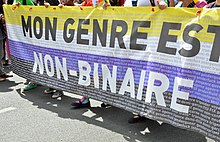
A non-binary pride flag at a parade in Paris reading "Mon genre est non-binaire" ("My gender is non-binary")
The term genderqueer originated in queer zines of the 1980s as a precursor to the term not-binary.[14] Information technology gained wider employ in the 1990s among political activists,[xv] especially Riki Anne Wilchins.[sixteen] Wilchins used the term in a 1995 essay published in the showtime effect of In Your Face to depict anyone who is gender nonconforming, and identified as genderqueer in their 1997 autobiography.[17] [xviii] Wilchins was also 1 of the master contributors to the anthology Genderqueer: Voices Beyond the Sexual Binary published in 2002.[19] The cyberspace allowed the term genderqueer to spread even further than zines, and by the 2010s the term was introduced to the mainstream via celebrities who publicly identified under the genderqueer umbrella.[fifteen]
Genderqueer is often used to cocky-place past people who challenge binary social constructions of gender.[20] [ page needed ] In addition to beingness an umbrella term for non-binary gender identities, genderqueer has been used as an adjective to refer to any people who are perceived to transcend or divert from traditional distinctions of gender, regardless of their gender identity. Individuals may express gender not-normatively by not befitting into the binary gender categories of "homo" and "woman".[21]
The term genderqueer has also been applied by those describing what they encounter as gender ambiguity.[22] [ page needed ] Androgynous (also androgyne) is frequently used every bit a descriptive term for people in this category. This is considering the term androgyny is closely associated with a blend of socially defined masculine and feminine traits.[23] [ folio needed ] Still, non all genderqueer people place as androgynous. Some genderqueer people identify as a masculine woman or a feminine human being or combine genderqueer with another gender option.[24] Being non-binary is non the same as being intersex, and most intersex people place as either male or female.[eleven] Some people use enby (from the letters 'NB') as a brusque form of not-binary.[25] [26]
Many references employ the term transgender to include genderqueer/non-binary people.[12] [27] [28] This use of the word as a wide term for various kinds of gender variation dates to at least 1992 and the publication of Transgender Liberation: A Motility Whose Time Has Come up past Leslie Feinberg.[fifteen] In 1994, non-binary writer Kate Bornstein wrote that "All the categories of transgender find a mutual ground in that they each break one or more of the rules of gender: What nosotros take in common is that we are gender outlaws, every i of united states."[29] The Homo Rights Entrada Foundation and Gender Spectrum apply the term gender-expansive to convey "a wider, more flexible range of gender identity and/or expression than typically associated with the binary gender organisation".[30]
Agender people ("a-" meaning "without"), also called genderless, gender-free, non-gendered, or ungendered,[31] [32] are those who identify as having no gender or being without a gender identity.[33] [34] [35] Although this category includes a wide range of identities which do not arrange to traditional gender norms, scholar Finn Enke states that people who place with any of these positions may not necessarily self-identify as transgender.[36] Agender people accept no specific set of pronouns; singular they is typically used, simply it is not the default.[37] Neutrois and agender were two of 50 bachelor custom genders on Facebook, which were added on xiii Feb 2014.[38] Agender is as well available as a gender option on OkCupid since 17 November 2014.[39]
Bigender (as well bi-gender or dual gender) people have two gender identities and behaviors. Identifying as bigender is typically understood to mean that one identifies as both male person and female or moves between masculine gender expression and feminine gender expression, having 2 distinct gender identities simultaneously or fluctuating between them.[40] [41] [42] This is different from identifying every bit genderfluid, as those who identify as genderfluid may not get back and forth between whatsoever fixed gender identities and may experience an entire range or spectrum of identities over time.[43] [44] The American Psychological Association describes the bigender identity as function of the umbrella of transgender identities.[45] Some bigender individuals express ii singled-out personas, which may exist feminine, masculine, agender, androgyne, or other gender identities; others notice that they place every bit two genders simultaneously. A 1999 survey conducted by the San Francisco Department of Public Health observed that, among the transgender community, 3% of those who were assigned male at birth and 8% of those who were assigned female at nascency identified as either "a transvestite, cross-dresser, drag queen, or a bigendered person".[46] A 2016 Harris poll conducted on behalf of GLAAD found that 1% of millennials identify as bigender.[47] [48] Trigender people shift among male person, female person, and third gender.[49]
Demigender people identify partially or mostly with one gender and at the aforementioned time with another gender.[50] [51] There are several subcategories of the identity. A demi-boy or demi-man, for example, identifies at to the lowest degree partially with being a male child or a human being (no matter the sex and gender they were assigned at birth) and partly with other genders or with no other gender (agender). A demiflux person feels that the stable role of their identity is non-binary.[51]
Pangender (also polygender or omnigender) people have multiple gender identities.[52] Some may place equally all genders at the same time.[53]
Genderfluid people often express a desire to remain flexible almost their gender identity rather than committing to a single definition.[54] They may fluctuate among differing gender expressions over their lifetime, or limited multiple aspects of various gender markers at the same time.[54] [55] A genderfluid individual may as well place as bigender, trigender, or pangender.[6] [7] [56]
Transfeminine is a term for any person, binary or non-binary, who was assigned male at birth and has a predominantly feminine gender identity or presentation; transmasculine is the equivalent term for someone who was assigned female at birth and has a predominantly masculine gender identity or presentation.[57]
In a 1990 Indigenous LGBT gathering in Winnipeg, the term two-spirit, which refers to third-gender or gender-variant people from Indigenous North American communities, was created "to distinguish and distance Native American/Beginning Nations people from not-Native peoples".[58]
History
In 1776, the Public Universal Friend identified equally a genderless evangelist, and afterward shunned both birth name and gendered pronouns,[59] [60] an early example of an American publicly identifying as not binary.[61]
In 1781, Jens Andersson of Kingdom of norway, assigned female at birth just identifying as male person, was imprisoned and put on trial later on getting married to Anne Kristine Mortensdotter in a Lutheran church. When asked most his gender, the response was "Hand troer at kunde henhøre til begge Deele" ("He believes he belongs to both").[62]
In 2012, the Intersex & Genderqueer Recognition Project was started to advocate for expanding gender options on official documentation.[63] In 2016, James Shupe was the beginning person to take a not-binary gender on official documents in the United States.[64]
In 2015, legislator Estefania Cortes-Vargas came out as non-binary in the Legislative Assembly of Alberta during a debate over the inclusion of transgender rights in the provincial human rights code.[65]
Pronouns and titles
| Mutual non-binary pronouns | |
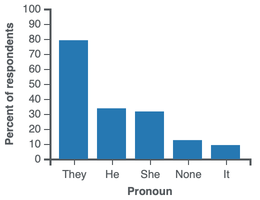 | |
| According to a 2021 survey, the five about pop pronoun sets used by non-binary people are they, he, she, none/avoid pronouns, and information technology.[66] | |
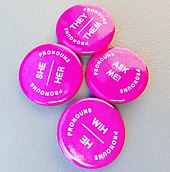
Pronoun pin badges from a 2016 art and tech festival
Some non-binary or genderqueer people utilize gender-neutral pronouns. In English, usage of singular "they", "their" and "them" is the about common;[66] [67] non-standard pronouns – unremarkably referred to as neopronouns[68] – such as xe, ze, sie, co, and ey are sometimes used also. Some others apply conventional gender-specific pronouns "he" or "she", alternately utilise "he" and "she", or use only their proper name and exercise not use pronouns at all.[69] Many apply additional neutral language, such as the title Mx.[70]
Legal recognition
Many non-binary/genderqueer people employ the gender they were given at birth to conduct everyday business, as many institutions and forms of identification – such every bit passports and commuter'due south licenses – only accept, in the sense of recorded recognition, binary gender identities. However, with the increasing credence of non-binary gender identities and the rise in wider societal recognition, this is slowly changing, as a greater number of governments and institutions recognize and allow non-binary identities.[2]
Multiple countries legally recognize non-binary or tertiary gender classifications. Some non-Western societies have long recognized transgender people as a third gender, though this may not (or may but recently)[71] include formal legal recognition. In Western societies, Australia may have been the first land to legally recognize a classification of sex outside of "male" and "female" on legal documentation, following the recognition of Alex MacFarlane'due south intersex status in 2003.[72] The wider legal recognition of non-binary people – following the recognition of intersex people in 2003 – in Australian law followed between 2010 and 2014, with legal action taken confronting the New South Wales Government Registry of Births, Deaths and Marriages by transgender activist Norrie May-Welby to recognize Norrie's legal gender identity as "not-specific". India's Supreme Court formally recognized transgender and not-binary people as a distinct third gender in 2014, following legal action taken by transgender activist Laxmi Narayan Tripathi.[73] In July 2021, Argentina incorporated non-binary gender in its national ID bill of fare, condign the showtime country in South America to legally recognize non-binary gender on all official documentation; non-binary people in the country volition have the selection to renew their ID with the letter "X" nether gender.[74] [75]
While the United States does non federally recognize a non-binary gender, in 2016 Oregon became the commencement state to recognize a not-binary gender identity.[76] Following Oregon, in 2017 California passed an act assuasive citizens to place as "non-binary" on official documents.[76] Every bit of 2019, eight states have passed acts that permit "non-binary" or "X" designations on certain identifying documents.[76] One of the master arguments confronting the inclusion of a third gender identifier in the U.S. is that it would make law enforcement and surveillance harder, even so countries that have officially recognized a third gender marking have non reported these issues.[76] In the Usa there are no explicit laws to protect non-binary people from discrimination, however it is illegal for an employer to crave employees to arrange to sex stereotypes.[77]
Bigotry
Diverse countries throughout history take criminalized transgender and non-binary gender identities.[78] [ ameliorate source needed ]
In the United States, the bulk of respondents to the National Transgender Discrimination Survey chose "A gender non listed here". The "not listed hither" respondents were nine percentage-points (33 percent) more likely to report forgoing healthcare due to fright of discrimination than the general sample (36 percent compared to 27 percent). Ninety percent reported experiencing anti-trans bias at work, and 43 pct reported having attempted suicide.[79]
The majority of reported discrimination faced past non-binary individuals oft includes disregard, disbelief, condescending interactions, and boldness.[76] People who are non-binary are also often viewed as partaking in function of a trend and are thus deemed insincere or attending-seeking. Every bit an accumulation, erasure is often a large form of discrimination faced by not-binary individuals.[76]
Misgendering is besides a problem that many individuals face, be it intentional or unintentional. In the case of intentional misgendering, transphobia is a driving force. Likewise, the use of they/them pronouns is lumped into the larger, controversial, bailiwick of safety spaces and political correctness,[fourscore] causing push dorsum, and intentional misgendering from some individuals.
Symbols and observances

Many flags accept been used in not-binary and genderqueer communities to represent diverse identities. There are singled-out not-binary and genderqueer pride flags. The genderqueer pride flag was designed in 2011 past Marilyn Roxie. Lavander represents androgyny or queerness, white represents agender identity, and greenish represents those whose identities which are defined outside the binary.[83] [84] [85] The non-binary pride flag was created in 2014 by Kye Rowan.[86] Xanthous represents people whose gender exists exterior the binary, purple represents those whose gender is a mixture of – or between – male and female, black represents people who have no gender, and white represents those who comprehend many or all genders.[87]
Genderfluid people, who besides autumn under the genderqueer umbrella, have their ain flag every bit well. Pink represents femininity, white represents lack of gender, purple represents mixed gender or androgyny, blackness represents all other genders, and blue represents masculinity.[84] [88]
Agender people, who also sometimes identify every bit genderqueer, have their own flag. This flag uses black and white stripes to represent an absence of gender, and a green stripe to represent non-binary genders.[89]
International Non-Binary People's Day is celebrated on 14 July.[xc] [91] [92] [93]
-

Agender pride flag
-

Bigender pride flag
-
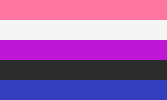
Genderfluid pride flag
-

Genderqueer pride flag
-
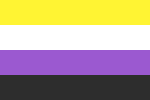
Non-binary pride flag
-

Non-binary gender symbol
Population figures
According to a 2021 written report past the Williams Institute, an estimated 1.two 1000000 American adults identify as non-binary, making up 11% of the LGBTQ adult population in the U.s..[96] A survey conducted in 2020 by The Trevor Project found that 26% of LGBTQ youth (ages 13–24) in the United States place as non-binary.[97] [98]
A 2019 survey of the Two-Spirit and LGBTQ+ population in Hamilton, Ontario, called Mapping the Void: Two-Spirit and LGBTQ+ Experiences in Hamilton showed that 19% of the 906 respondents identified as non-binary.[99]
A 2017 survey of Canadian LGBT+ people called LGBT+ Realities Survey found that 4% of the i,897 respondents identified as non-binary transgender and ane% identified as non-binary outside of the transgender umbrella.[100]
According to The Report of the 2015 U.Due south. Transgender Survey, 35% of the near 28,000 transgender respondents to the anonymous online survey identified every bit non-binary.[101] [102]
A 2011 survey conducted past the Equality and Human Rights Commission in the Uk plant that 0.4% of the 10,039 respondents identified every bit non-binary. Information technology does not allow inference nearly the share of not-binary people in the whole population, since the survey sample was not necessarily representative. The purpose of the survey was to test if respondents are willing to answer questions almost their transsexual status.[103] :4-5
A 2021 survey found that 0.4% of adults in Switzerland describe themselves as non-binary.[104] The survey of 2,690 Swiss residents was weighted to be cogitating of the entire population.[105]
See also
 | Look up not-binary in Wiktionary, the free dictionary. |
- Genderqueer fashion
- Gender neutrality
- Gender-neutral language
- Gender neutrality in languages with grammatical gender
- Gender neutrality in genderless languages
- Gender neutrality in English language
- Gender marking in job titles
- Gender-specific and gender-neutral pronouns
- Gender-neutral language
- Gender variance
- List of fictional non-binary characters
- Listing of people with non-binary gender identities
- Postgenderism
- Transcending Boundaries Conference
- Gender transitioning
- Two-Spirit
Notes
- ^ Besides spelled nonbinary. The term enby, from the abbreviation "NB", is also used.[1]
References
- ^ Bergman, South. Behave; Barker, Meg-John (2017). "Not-binary Activism". In Richards, Christina; Bouman, Walter Pierre; Barker, Million-John (eds.). Genderqueer and Non-Binary Genders. Disquisitional and Applied Approaches in Sexuality, Gender and Identity. Palgrave Macmillan. p. 43. ISBN978-i-137-51052-five.
{{cite book}}: CS1 maint: url-status (link) - ^ a b Richards, Christina; Bouman, Walter Pierre; Seal, Leighton; Barker, Million John; Nieder, Timo O.; T'Sjoen, Guy (2016). "Non-binary or genderqueer genders". International Review of Psychiatry. 28 (1): 95–102. doi:x.3109/09540261.2015.1106446. hdl:1854/LU-7279758. PMID 26753630. S2CID 29985722. Archived from the original on 26 June 2019. Retrieved nine June 2019.
- ^ a b "Supporting & Caring for Transgender Children" (PDF). Human Rights Campaign. Archived from the original (PDF) on 24 July 2021. Retrieved 8 April 2021.
- ^ "Trans + Gender Identity". The Trevor Project. Archived from the original on 4 July 2018. Retrieved 11 Oct 2019.
- ^ Beemyn, Brett Genny (2008). "Genderqueer". glbtq: An Encyclopedia of Gay, Lesbian, Bisexual, Transgender, and Queer Culture. Chicago, Illinois: glbtq, Inc. Archived from the original on 25 April 2012. Retrieved three May 2012.
- ^ a b Bosson, Jennifer K.; Vandello, Joseph A.; Buckner, Camille E. (2018). The Psychology of Sex and Gender. Thousand Oaks, California: Sage Publications. p. 54. ISBN978-ane-5063-3134-8. OCLC 1038755742. Archived from the original on 28 May 2020. Retrieved 4 August 2019.
- ^ a b Whyte, Stephen; Brooks, Robert C.; Torgler, Benno (25 September 2018). "Human, Woman, "Other": Factors Associated with Nonbinary Gender Identification". Archives of Sexual Behavior. Heidelberg, Germany: Springer Science+Concern Media. 47 (8): 2397–2406. doi:x.1007/s10508-018-1307-iii. PMID 30255409. S2CID 52823167.
2 out of 7479 (0.03 percent) of respondents to the Australian Sex Survey, a 2016 online enquiry survey, self-identified as trigender.
- ^ Wintertime, Claire Ruth (2010). Understanding Transgender Multifariousness: A Sensible Explanation of Sexual and Gender Identities. Scotts Valley, California: CreateSpace. ISBN978-one-4563-1490-three. OCLC 703235508. [ page needed ]
- ^ "Transgender Glossary of Terms". GLAAD Media Reference Guide. Gay & Lesbian Brotherhood Confronting Defamation. Archived from the original on iii June 2012. Retrieved 25 May 2011.
- ^ Stryker, Susan (2008). Transgender History. Berkeley, California: Seal Press. ISBN978-1-58005-224-five. OCLC 183914566. [ page needed ]
- ^ a b "Understanding Not-Binary People: How to Exist Respectful and Supportive". National Centre for Transgender Equality. ix July 2016. Archived from the original on six April 2020. Retrieved 17 June 2020.
- ^ a b Schorn, Johanna. "Taking the "Sex activity" out of Transsexual: Representations of Trans Identities in Popular Media" (PDF). Inter-Disciplinary.Net. Cologne, Deutschland: University of Cologne. p. 1. Archived from the original (PDF) on 25 October 2014. Retrieved 23 October 2014.
The term transgender is an umbrella term "and mostly refers to any and all kinds of variation from gender norms and expectations" (Stryker 19). Nearly often, the term transgender is used for someone who feels that the sex activity assigned to them at birth does not reflect their own gender identity. They may identify as the gender "reverse" to their assigned gender, or they may feel that their gender identity is fluid, or they may reject all gender categorizations and place equally agender or genderqueer.
- ^ Hastings, Jennifer (17 June 2016). "Approach to genderqueer, gender non-befitting, and gender nonbinary people". UCSF Transgender Intendance. Archived from the original on 6 October 2021. Retrieved ten Oct 2021.
- ^ Hendrie, Theo, ed. (2019). X Marks the Spot: An Anthology of Nonbinary Experiences. p. 238. ISBN978-one-0809-6803-9.
- ^ a b c Tobia, Jacob (7 November 2018). "InQueery: The History of the Word 'Genderqueer' As Nosotros Know It". them. Condé Nast. Archived from the original on iv Apr 2020. Retrieved 18 February 2020.
- ^ Wilchins, Riki (fourteen March 2017). "Go to Know the New Pronouns: They, Theirs, and Them". Pride. Archived from the original on 18 February 2020. Retrieved 18 February 2020.
- ^ "Genderqueer History". Archived from the original on 12 Nov 2018. Retrieved 2 Nov 2018.
- ^ Wilchins, Riki (Spring 1995). "A Note from your Editrix" (PDF). In Your Confront (ane): 4. Archived (PDF) from the original on five October 2020. Retrieved 18 February 2020.
- ^ Nestle, Joan; Howell, Clare; Wilchins, Riki Anne, eds. (2002). GenderQueer : voices from across the sexual binary (1st ed.). New York Urban center: Alyson Books. ISBN978-ane-55583-730-three. OCLC 50389309.
- ^ Shaw, Susan; Lee, Janet (23 April 2014). Women's voices, feminist visions : classic and contemporary readings (Sixth ed.). New York. ISBN978-0-07-802700-0. OCLC 862041473.
- ^ Dahir, Mubarak (25 May 1999). "Whose Movement Is Information technology?". The Advocate. San Francisco, California: Here Media. p. 52.
- ^ Girshick, Lori B. (2008). Transgender Voices: Beyond Women and Men. Hanover, New Hampshire: Academy Printing of New England. ISBN978-ane-58465-645-6. OCLC 183162406.
- ^ Shaw, Susan M.; Lee, Janet (2015). Women'due south Voices, Feminist Visions (6 ed.). New York City: McGraw-Hill Education.
- ^ Walsh, Reuben (December 2010). "More than T, vicar? My experiences every bit a genderqueer person of organized religion". All God's Children. Vol. two, no. 3. Lesbian and Gay Christian Motion.
- ^ Sheridan, Vanessa (2018). Transgender in the Workplace: The Complete Guide. p. 11. ISBN978-1440858062.
- ^ Hope, Sam (2019). Person-Centred Counselling for Trans and Gender Diverse People. London, England: Jessica Kingsley Publishers. p. 218. ISBN978-1784509378.
- ^ Vargo, Marc E. (xxx November 2011). "A Review of Please select your gender: From the invention of hysteria to the democratizing of transgenderism". Periodical of GLBT Family Studies. vii (5): 2 (493). doi:x.1080/1550428X.2011.623982. ISSN 1550-4298. S2CID 142815065.
upwardly to three million U. S. citizens regard themselves equally transgender, a term referring to those whose gender identities are at odds with their biological sexual practice. The term is an expansive one, however, and may employ to other individuals also, from the person whose beliefs purposely and dramatically diverges from order's traditional male person/female roles to the "agender", "bigender" or "tertiary gender" person whose self-definition lies outside of the male/female binary altogether. In curt, those counted under this term constitute a wide array of people who practise not conform to, and may actively challenge, conventional gender norms.
- ^ Cronn-Mills, Kirstin (2014). "Four. Trans*spectrum. Identities". Transgender Lives: Circuitous Stories, Complex Voices. Minneapolis, Minnesota: Twenty-Offset Century Books. p. 24. ISBN978-1-4677-4796-7. Archived from the original on viii April 2019. Retrieved 23 October 2014.
Many different individuals fall under what experts phone call the trans* spectrum, or the trans* umbrella."I'm trans*" and "I'm transgender" are ways these individuals might refer to themselves. Only there are distinctions among different trans* identities. [...] Androgynous individuals may non place with either side of the gender binary. Other individuals consider themselves agender, and they may feel they accept no gender at all.
- ^ Bornstein, Kate (2013). Gender Outlaw: On Men, Women and the Remainder of U.s.a.. Abingdon, England: Routledge. ISBN978-1-136-60373-0. Archived from the original on ten March 2021. Retrieved xix October 2020.
- ^ "Supporting and Caring for our Gender-Expansive Youth" (PDF). Human Rights Campaign. Archived from the original (PDF) on 29 January 2016. Retrieved 21 May 2021.
- ^ "LGBTQ Needs Assessment" (PDF). Encompass Network. April 2013. pp. 52–53. Archived from the original (PDF) on 24 October 2014. Retrieved 18 October 2014.
- ^ "Gender alphabet" (PDF). Prophylactic Homes. p. 1. Archived (PDF) from the original on 15 April 2015. Retrieved xviii Oct 2014.
- ^ Vargo, Marc East. (2011). "A Review of "Delight select your gender: From the invention of hysteria to the democratizing of transgenderism"". Periodical of GLBT Family Studies. 7 (5): 493–494. doi:x.1080/1550428x.2011.623982. S2CID 142815065.
- ^ Cronn-Mills, Kirstin (2014). Transgender Lives: Circuitous Stories, Complex Voices. Twenty-Showtime Century Books. ISBN978-1-4677-4796-7. Archived from the original on two December 2016. Retrieved 3 Feb 2016.
- ^ Schorn, Johanna (22 February 2016). "Taking the "Sex" out of Transsexual: Representations of Trans Identities in Popular Media".
- ^ Anne Enke, ed. (2012). "Annotation on terms and concepts". Transfeminist Perspectives In and Across Transgender and Gender Studies. Temple University Printing. pp. 16–20 [18–19]. ISBN978-1-4399-0748-1.
- ^ Sojwal, Senti (16 September 2015). "What Does "Agender" Hateful? 6 Things To Know About People With Non-Binary Identities". Bustle. Archived from the original on 22 February 2016. Retrieved 22 February 2016.
- ^ Sparkes, Matthew (xiv February 2014). "Facebook sex activity changes: which ane of fifty genders are you?". The Daily Telegraph. Archived from the original on 21 May 2018. Retrieved v Apr 2018.
- ^ "OkCupid expands gender and sexuality options". PBS NewsHour. 17 November 2014. Archived from the original on 19 November 2014. Retrieved 18 November 2014.
- ^ Edwards, Ruth Dudley (17 August 2014). "Asexual, bigender, transexual or cis, tin't nosotros all simply exist kind to each other?". The Independent. Archived from the original on 18 December 2019. Retrieved 18 December 2019.
- ^ Persio, Sofia Lotto (xvi June 2017). "Oregon becomes first state to allow pick "X" to cease gender binary". Newsweek. Archived from the original on eighteen December 2019. Retrieved 18 Dec 2019.
- ^ "Everything yous ever wanted to know virtually being nonbinary". The Daily Dot. 28 September 2017. Archived from the original on 28 September 2019. Retrieved eighteen December 2019.
- ^ "Billy Dee Williams: What is gender fluid?". Monsters and Critics. 2 December 2019. Archived from the original on 18 December 2019. Retrieved 18 December 2019.
- ^ "This is the term for people who aren't exclusively male or female". PinkNews. 26 April 2018. Archived from the original on eighteen December 2019. Retrieved 18 December 2019.
- ^ "Sexual orientation and gender identity". Archived from the original on 2 January 2020. Retrieved eighteen December 2019.
- ^ Clements, G. San Francisco Section of Public Health Archived 15 September 2006 at the Wayback Motorcar, 1999
- ^ "EEOC at present gives nonbinary people a manner to be counted in workplace". ThinkProgress. Archived from the original on eighteen Dec 2019. Retrieved 18 Dec 2019.
- ^ "Accelerating Acceptance 2017" (PDF). GLAAD. Archived (PDF) from the original on vi January 2020. Retrieved 27 December 2019.
- ^ Bosson, Jennifer Thousand.; Vandello, Joseph A.; Buckner, Camille Due east. (17 January 2018). The Psychology of Sex and Gender. SAGE Publications. ISBN978-ane-5063-3134-8.
- ^ Gibson, Sarah; Fernandez, J. (2018). Gender Diversity and Non-Binary Inclusion in the Workplace: The Essential Guide for Employers. London: Jessica Kingsley Publishers. p. 25. ISBN978-one-78450-523-3.
- ^ a b Brill, Stephanie; Kenney, Lisa (2016). The Transgender Teen. Berkeley, California: Cleis Press. p. 311. ISBN978-1627781749.
- ^ Ginicola, Misty Thou.; Smith, Cheri; Filmore, Joel M. (10 February 2017). Affirmative Counseling with LGBTQI+ People. John Wiley & Sons. p. 366. ISBN978-1-119-37549-4.
- ^ "Queer Undefined". Queer Undefined. Archived from the original on 21 Jan 2021. Retrieved 10 October 2020.
- ^ a b Cronn-Mills, Kirstin (2015). Transgender Lives: Complex Stories, Complex Voices. Minneapolis, Minnesota: Twenty-First Century Books. p. 24. ISBN978-0-7613-9022-0.
- ^ McGuire, Peter (9 November 2015). "Beyond the binary: what does information technology hateful to be genderfluid?". The Irish Times. Archived from the original on 22 Nov 2015. Retrieved 1 Dec 2015.
- ^ Ferguson, Sian (eleven June 2020). "What Does It Mean to Exist Gender Fluid?". Healthline . Retrieved 23 June 2021.
- ^ Mardell, Ashley (2016). The ABC's of LGBT+. Coral Gables, Florida: Mango Media Inc. p. 96. ISBN978-1-63353-408-7. Archived from the original on 1 August 2020. Retrieved fourteen December 2019.
- ^ de Vries, Kylan Mattias (2009). "Berdache (Two-Spirit)". In O'Brien, Jodi (ed.). Encyclopedia of gender and society. Los Angeles: SAGE. p. 64. ISBN9781412909167 . Retrieved six March 2015.
- ^ Wisbey, Herbert A., Jr. (2009) [1964]. Pioneer Prophetess: Jemima Wilkinson, the Publick Universal Friend. Cornell University Printing. pp. vii–14. ISBN978-0-8014-7551-i.
- ^ Moyer, Paul B. (2015). The Public Universal Friend: Jemima Wilkinson and Religious Enthusiasm in Revolutionary America . Cornell University Press. pp. 12, 18, 100. ISBN978-0-8014-5413-4.
- ^ Samantha Schmidt, A genderless prophet drew hundreds of followers long earlier the age of nonbinary pronouns, Jan 5, 2020, The Washington Post
- ^ "Et besynderligt givtermaal mellem tvende fruentimmer". Skeivt arkiv. 16 December 2014. Retrieved 7 September 2021.
- ^ "About United states of america – Intersex & Genderqueer Recognition Project (IGRP)". igrp. Archived from the original on 4 April 2020. Retrieved 9 December 2019.
- ^ O'Hara, Mary Emily (16 December 2016). "Movement for third gender option 'exploding' in U.S." NBC News. Archived from the original on eighteen October 2019. Retrieved 9 December 2019.
- ^ "An Alberta MLA on battling gender identity". Maclean's, Dec i, 2015
- ^ a b "Gender Demography 2021: Worldwide Report". Gender Census. one April 2021. Retrieved xvi Apr 2021.
- ^ Hekanaho, Laura (eight December 2020). Generic and Nonbinary Pronouns: Usage, Acceptability and Attitudes (PDF) (PhD). Academy of Helsinki. p. 221. ISBN978-9515168313. Archived (PDF) from the original on seven March 2021. Retrieved 7 March 2021.
- ^ Marcus, Ezra (eight April 2021). "A Guide to Neopronouns". The New York Times. ISSN 0362-4331. Archived from the original on 28 Dec 2021. Retrieved 30 April 2021.
- ^ Feinberg, Leslie (1996). Transgender Warriors: Making History from Joan of Arc to Dennis Rodman . Boston, Massachusetts: Beacon Printing. ISBN978-0-8070-7940-ix. OCLC 33014093.
- ^ Pearce, Ruth (21 July 2011). "Non-gendered titles see increased recognition". Lesbilicious. Archived from the original on 18 September 2019. Retrieved 29 August 2012.
- ^ "Pakistani eunuchs to have singled-out gender". BBC News. 23 December 2009. Archived from the original on 18 May 2020. Retrieved 23 December 2009.
- ^ "Newsletter of the Folklore of Sexualities Section of the American Sociological Clan" (PDF). American Sociological Association Sexualities News. 6 (1). Summer 2003. Archived (PDF) from the original on iv March 2016. Retrieved 9 Dec 2013.
- ^ McCarthy, Julie (15 April 2014). "In India, Landmark Ruling Recognizes Transgender Citizens". NPR . Retrieved 30 April 2021.
- ^ "Alberto Fernández pone en marcha el DNI para personas no binarias en un paso más por la igualdad de género". www.clarin.com (in Spanish). 21 July 2021. Retrieved 26 July 2021.
- ^ Westfall, Sammy (22 July 2021). "Argentine republic rolls out gender-neutral ID". The Washington Post . Retrieved 27 July 2021.
- ^ a b c d e f "They, Them, and Theirs". harvardlawreview.org. Archived from the original on 5 December 2019. Retrieved ix December 2019.
- ^ Cecka, Dale Margolin; Chamallas, Martha (2016). "Price Waterhouse five. Hopkins, 490 U.S. 228 (1989)". Feminist Judgments. Feminist Judgments: Rewritten Opinions of the United States Supreme Court. pp. 341–360. doi:x.1017/cbo9781316411254.020. ISBN978-1-107-12662-6.
- ^ Wareham, Jamie. "New Written report Shows Where It's Illegal To Exist Transgender In 2020". Forbes . Retrieved 30 April 2021.
- ^ Harrison, Jack; Grant, Jaime; Herman, Jody L. "A Gender Not Listed Here: Genderqueers, Gender Rebels, and OtherWise in the National Transgender Discrimination Survey" (PDF). Archived from the original (PDF) on 25 July 2012. Retrieved 29 April 2013.
- ^ Richards, Christina; Bouman, Walter Pierre; Barker, Meg-John (2017). Genderqueer and Not-Binary Genders. Springer. ISBN978-one-137-51053-2. Archived from the original on 2 March 2021. Retrieved 19 October 2020.
- ^ "One Who Fights For an Other". The New Indian Limited. Archived from the original on 24 September 2016. Retrieved 11 May 2015.
- ^ "Worldwide gay rights as a social movement picks up". merinews.com. Archived from the original on 2 August 2017. Retrieved 12 May 2017.
- ^ Deater, Lynn (29 April 2015). "He, She or They? » The Commuter". ncccommuter.org. Archived from the original on 21 December 2016. Retrieved xx December 2016.
- ^ a b "Flags and Symbols" (PDF). www.amherst.edu. Amherst, Massachusetts: Amherst Academy. Archived (PDF) from the original on 10 May 2017. Retrieved 20 Dec 2016.
- ^ "Gender and Sexuality Awareness Flags". David Mariner. 26 October 2015. Archived from the original on 3 February 2017. Retrieved twenty December 2016.
- ^ "viii Things Non-Binary People Demand to Know". Let'southward Queer Things Up!. 15 March 2015. Archived from the original on 22 Dec 2016. Retrieved xx Dec 2016.
- ^ "Afterwards counting up all the 'votes' for each variation of my nonbinary flag (to exist dissever from the genderqueer flag), it seems this is the well-nigh loved! Yay!". genderweird. Tumblr. Archived from the original on 24 June 2018. Retrieved 24 June 2018.
- ^ "Gender-fluid added to the Oxford English Dictionary". LGBTQ Nation. Archived from the original on 25 Oct 2016. Retrieved twenty December 2016.
- ^ Manzella, Samantha (vii October 2017). "Beyond The Rainbow: Your Guide To LGBT Flags". NewNowNext. Archived from the original on 25 June 2018. Retrieved 25 June 2018.
- ^ Mathers, Charlie (xiii July 2018). "Prepare for International Non-binary Day by learning how to be a meliorate ally". Gay Star News. Archived from the original on 14 July 2018. Retrieved 14 July 2018.
- ^ Hirst, Jordan (x July 2018). "Inclusive Brisbane Party To Mark International Non-Binary Mean solar day". QNEWS Magazine. Archived from the original on 14 July 2018. Retrieved fourteen July 2018.
- ^ "Important LGBT Dates". LGBT LifeWestchester. White Plains, NY. Archived from the original on 26 June 2019. Retrieved 12 June 2019.
- ^ "International Non-Binary People's Day". Pride Inclusion Programs. acon. Archived from the original on 3 August 2019. Retrieved 12 June 2019.
- ^ Gray, Emma; Vagianos, Alanna (27 July 2017). "We Take A Navy Veteran To Thank For The Transgender Pride Flag". Huffington Post. Archived from the original on 1 September 2018. Retrieved 31 August 2017.
- ^ LB, Branson (26 July 2017). "The Veteran Who Created The Trans Pride Flag Reacts To Trump's Trans Military Ban". Buzzfeed. Archived from the original on 1 September 2018. Retrieved 31 August 2018.
- ^ Wilson, Bianca D.M.; Meyer, Ilan H. (June 2021). "Nonbinary LGBTQ Adults in the United States". Williams Institute. Retrieved 25 June 2021.
- ^ Ennis, Dawn (13 July 2021). "New Inquiry Reveals Insights Into America's Nonbinary Youth". Forbes . Retrieved half-dozen January 2022.
- ^ "Diversity of Nonbinary Youth". The Trevor Projection. 13 July 2021. Retrieved 6 January 2022.
- ^ "Mapping the Void: Two-Spirit and LGBTQ+ Experiences in Hamilton" (PDF). eleven June 2019. Archived (PDF) from the original on iii July 2019. Retrieved 19 July 2019.
- ^ "The values, needs and realities of LGBT people in Canada in 2017". 2017. Archived from the original on 27 July 2019. Retrieved 27 July 2019.
- ^ Cummings, William (21 June 2017). "When asked their sexual activity, some are going with pick 'X'". United states Today. Archived from the original on 4 February 2019. Retrieved xxx January 2019.
- ^ "The Written report of the 2015 U.Southward. Transgender Survey" (PDF). National Centre for Transgender Equality. 2016. p. 45. Archived (PDF) from the original on 9 May 2018. Retrieved thirty May 2019.
- ^ Glen, Fiona; Hurrell, Karen (2012). "Technical annotation: Measuring Gender Identity" (PDF). Equality and Human being Rights Committee. Archived (PDF) from the original on 2 August 2019. Retrieved 30 May 2019.
- ^ "Only 0.4% of Swiss residents describe themselves as not-binary". SWI swissinfo.ch. 29 December 2021. Retrieved 6 Jan 2022.
- ^ "Geschlechtergerechter: Studie #i Geschlecht und Identität" (PDF). Sotomo. December 2021. p. 5. Retrieved 6 January 2022.
Further reading
- Barker, Million-John; Scheele, Julia. (2016). Queer: A Graphic History. London: Icon Books. ISBN 978-1-78578-071-4. OCLC 939427299.
- Bernstein Sycamore, Mattilda, ed. (2006). Nobody Passes: Rejecting the Rules of Gender and Conformity. Emeryville: Seal Printing. ISBN978-1-58005-184-two. OCLC 50389309.
- Bornstein, Kate; Bergman, S. Bear, eds. (2010). Gender Outlaws: The Next Generation (Reprint ed.). Berkeley: Seal Printing. ISBN978-1-58005-308-ii. OCLC 837948378.
- Fine, Cordelia (2011). Delusions of Gender: How Our Minds, Guild, and Neurosexism Create Difference (Reprint ed.). New York: West. W. Norton & Company. ISBN978-0-393-34024-2. OCLC 449865367.
- Fineman, Martha Albertson (2013). "Feminism, masculinities, and multiple identities". Nevada Law Journal. 13 (2): sixteen.
- Hines, Melissa (2005). Encephalon Gender. Oxford University Press. ISBN978-0-19-518836-iii. OCLC 846105995.
- Nestle, Joan; Howell, Clare; Wilchins, Riki Anne, eds. (2002). GenderQueer: Voices from Across the Sexual Binary. Los Angeles: Alyson Books. ISBN978-1-55583-730-three. OCLC 50389309.
- Peterson, Tim Trace; Tolbert, T. C., eds. (2013). Troubling the Line: Trans and Genderqueer Poetry and Poetics. Callicoon: Nightboat Books. ISBN978-ane-937658-10-6. OCLC 839307399.
- Richards, C., Bouman, W. P., & Barker, Thousand.-J. (2017). Genderqueer and non-binary genders. London: Palgrave Macmillan. ISBN 978-1-137-51052-5. OCLC 1021393997.
- Spotter, Ph.D. (23 July 2013). "(A) Male, (B) Female, (C) Both, (D) Neither". The Huffington Mail service. AOL. Archived from the original on 27 July 2013. Retrieved 2 August 2013.
- Stryker, Susan; Whittle, Stephen, eds. (2006). The Transgender Studies Reader. New York]: Routledge. ISBN978-1-58005-184-ii. OCLC 50389309.

Source: https://en.wikipedia.org/wiki/Non-binary_gender
Posted by: jacksonhicappeed.blogspot.com
0 Response to "options for non gender binary pronounds"
Post a Comment